
And no I don't mean popping pills ;0
I see the benefit in acupuncture, rolfing, physical therapy, Egoscue, as well as complementary therapies such as yoga, mediation, reiki as well as martial arts. Here is an article I pulled from Mike Boyle's StrengthCoach.com a week or so ago.
It Hurts Right Here: The Mystery of Pain
 |  |
Of the many reasons people seek out medical (allopathic or alternative) care, the number one reason is usually for some sort of pain, be it from an acute injury or some type of chronic or distressing condition. According to the Centers for Disease Control (http://www.cdc.gov/), the number one prescribed class of drugs is analgesics, which are painkillers. However, since few fitness/S & C professionals are also doctors with a license to prescribe drugs, our focus in this article is on non-pharmaceutical approaches to dealing with pain. Specifically, we are going to be dealing with athletic-type of painful conditions that are quite common in an active and athletic population and even in sedentary populations as well (although for different reasons). We'll start this article by discussing many of the common reasons people suffer pain (other than the obvious ones like acute, traumatic injury). Then, we'll discuss how many of the common approaches to treating painful conditions, including limiting treatment to primarily the site of pain, are less than optimal and even counter-productive!
Development of Pain in the Myofascial Tissues
One of the most common sources of many aches and pains in the body are local areas of dysfunction in the musculo-tendonous tissues called myofascial trigger points. This term was originally coined by the late Dr. Janet Travel M.D., who pioneered the entire field of myofascial pain and dysfunction and really spearheaded the entire field of treatment for trigger points. In the second edition of the landmark text by Travell and her esteemed colleague Dr. David Simons M.D., a precise definition was given that we will use for explaining what a trigger point (TrP) actually is:
A hyperirritable spot in skeletal muscle that is associated with a hypersensitive palpable nodule in a taut band. The spot is painful upon compression and can give rise to characteristic referred pain, referred tenderness, motor dysfunction, and autonomic phenomenon.
Since so many fitness/health professionals throw theTrP term around so loosely we thought it was important to make sure we are being accurate with our current scientific understanding of the whole trigger point phenomenon. It must be remembered that much of the following information in only theoretical, the best scientific understanding we have at the current moment. Some of this information is tentative and must not be taken as "gospel." We only highlight these concepts to stimulate a little deeper thinking on the subject at hand.
Are All Painful Spots Trigger Points?
There are some experts that do not fully embrace the trigger point theory/hypothesis and it should be known that not all tender spots upon palpation are trigger points. Some of tender spots could actually be entrapped, compressed, or overly stretched nerves (sub-cutaneous sensory or even deeper peripheral nerves); in fact, David Butler, the Australian Physiotherapist who has helped popularize and develop the field of neurodynamics, has coined the term AIGS (abnormal impulse generating sites) to signify painful sites on the body that might be related to more of a nervous system dysfunction that just a sore or tender muscle/tendon area. Any way you slice it, pain is a nervous system phenomenon; so speaking just of muscles, fascia, bones, ligaments and tendons without mention of the actual nerves which supply them and relay information to and from the CNS (central nervous system) is missing the boat. AIGS are another way to think of painful sites in the body.
How Do You Know if You're Dealing with TrP's?
The basic criterion for the diagnosis of a TrP is a painful/tender area upon compression with a sensation of referred pain to a distant area, often remote from the spot being compressed or palpated. Furthermore, if the person recognizes the referred pain then the TrP can be classified as an active trigger point, and if the referred sensation is new or unknown to the individual, then it is classified as a latent trigger point.
Then, there is the classification of central trigger points and attachment trigger points. The central trigger points tend to develop in the center or "belly" of a muscle and can lead to excessive tension (pulling) on either end of the tendons. Initially, this can lead to tendon problems (i.e. tendonitis and inflammation) and if these tensile stresses continue long enough, eventual calcification and degenerative changes can occur to these tendons (i.e. tendonosis & enthesitis).
Two other classifications of TrP's that need to be understood in this article are the concepts of "key" and "satellite" trigger points. The basic theory here is that until key TrP's are released, which are usually in larger more proximal muscles, the satellite TrP's will not release or will return rapidly after treatment. So what this also means is that often, just by effectively treating the key TrP's, the satellite ones will diminish or go away completely without any direct treatment. A good example of this would phenomenon would be TrP's in the lateral hip musculature, the gluteus medius or minimus. If a key trigger point were treated in the Quadratus Lumborum (QL for short) prior to treating the glutes, the therapy would be more effective and longer lasting. If the QL and lumbar muscles were not treated, the TrP's in the lateral hip area might not diminish their TrP activity and referral patterns. This concept of key and satellite TrP's can also be effectively applied to the fascial connections or "train" theories of Rolfer Thomas Myers.
Applying Trigger Point referrals to myofascial lines
Now that we have a fundamental understanding of what trigger points are, how they work, and how to treat them, we can begin to apply this information to myofascial lines and attempt to trace some of our mysofascial tension back to its origin.
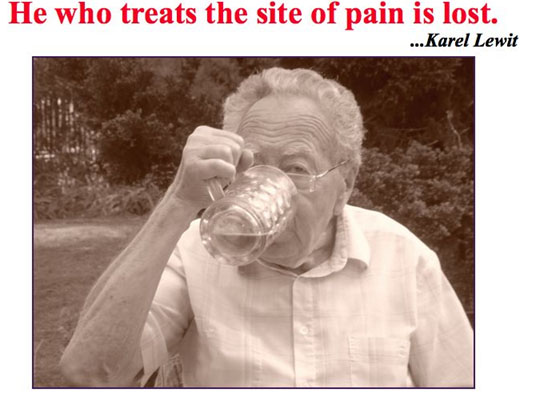
Oftentimes clients come in and we perform soft tissue therapy on the area that they complain of pain. However, our results may only be temporary - the individual reports feeling better for a couple of days only to have the pain return.
This is where having an understanding of myofascial lines and knowing your trigger point referral patterns can help you in searching for the source of soft tissue pain and dysfunction instead of just treating the site.
Thomas Myers, a Rolfer by trade who was trained by Ida Rolf, brought the concept of myofascial lines, or what he called "trains", to popularity. Myers proposed several fascial lines that connect the upper and lower extremity and show how dysfunctional patterns in the lower extremity could potentially have a negative impact on the upper extremity. The fascial lines are:
The Superficial Back Line
The Superficial Front Line
The Lateral Line
The Spiral Line
The Deep Front Line
Back of the Arm Lines
Front of the Arm Lines
We encourage you to check out Myers' work in order to gain a better understanding of all of these lines and how they affect movement of the body. For the purposes of this article, we will use the lateral line as an example of how to investigate soft tissue to decrease pain and improve overall function.
The lateral line begins at the foot with the peroneal muscles that travel up the outside of the lower leg to attach onto the fibular head and share a fascial connection to the IT-band. The IT-band then travels up the outside of the leg and forms into the gluteus maximus, tensor fascia latae and partially the gluteus medius. These muscles serve as the attachment for this line into the iliac crest. From the iliac crest, the lateral line continues into the internal and external obliques and the QL which all attach to the lower ribs. From the lower ribs, the lateral line blends into the fascia of the intercostals and continues up the body until it reaches the fascia of the splenius cervicis, SCM and scalenes.
Now that we see the connection that these muscles share, we can begin to piece together a treatment plan for an individual who may be experiencing lateral ankle pain or coming back from an inversion ankle sprain.
An inversion sprain is one in which the individual rolls their ankle -- think running and slipping off the sidewalk and rolling over your ankle. This injury can range in severity and the pain (and possibly inflammation) this injury causes can inhibit our movement as our body figures a new strategy to move that is less painful.
The peroneal muscles, the muscles on the outside of our lower leg, functional primarily to evert or pronate the foot. During an inversion sprain, these muscles are rapidly placed on stretch and subject to a high amount of trauma.
It has been documented that following an ankle sprain, individuals may be subject to hip abductor weakness. This is especially true if the individual is placed in a boot to stabilize the ankle and prevent movement while healing takes place. Our main hip abductors are the gluteus minimus, TFL, and gluteus maximus -- the three muscles that make up the IT-band and three of the muscles that share a fascial connection to the peroneals in Myer's lateral line.
Moving further up the lateral line, the Quadratus Lumborum (QL) can house trigger points or increased tone following an inversion sprain because it is recruited to help move keep pressure off the injured foot when walking -- this is especially true in individuals who are placed in an immobilization boot.
Linking science to practice
Following rehabilitation from an ankle sprain, it may be common for the individual to have residual pain or movement dysfunction. As we have just shown, the pain in the lateral ankle and the accompanying movement dysfunctions may be caused because of trigger points or fascial tension which were initially developed to help the body move safely in a time of injury; however, are no longer needed or desirable as the individual is prepared to move back to sports activity.
Instead of treating the site of pain -- the ankle -- we propose that the therapist start further up and begin by investigating the QL, then the hips (paying special attention to TFL, Gluteus Medius, and Gluteus Maximus), move down the IT-band, into the peroneals and finally the ankle, which you may find no longer is painful after the work performed higher up. In addition to tracing the fascial lines higher up the chain, by working proximal to distal in this manner you also are able enhance blood and lymph flow. In the case of a chronic ankle sprain, working the ankle directly may be contraindicated due to swelling, inflammation, and pain. While you are allowing the tissue around the ankle to heal, you can work with the fascial chains higher up to facilitate the healing process and create healthy lymph flow to help the swelling decrease.
Conclusions
Well, we hope that this article has stimulated some good thought processes on how to approach pain lingering after an athletic injury such as a lateral ankle sprain. We also hope that coaches, trainers, and therapists realize that you can't just treat the site of pain if optimal recovery and return of function is to occur. As we've all heard a million times, the body is "all connected" and is kinetic chain that is linked together mechanically, neurologically, and fascially. Through the theories of trigger point development and treatment, as well as an understanding of the fascial connections of the body, we demonstrated the process that one must take when addressing common injury and pain syndromes. We hope you enjoyed that article and the videos!
About The Authors:
Keats Snideman is the owner of Reality Based Fitness -- www.realitybasedfitness.com. Patrick Ward is the owner of Optimum Sports Performance -- www.optimumsportsperformance.com. Together they own the Reality Based Fitness/Optimum Sports Performance Training facility in Tempe, AZ, where they offer sport conditioning and soft tissue therapy to athletes and clients of all levels and abilities. In addition, they both host the Reality Based Fitness Podcast -- www.realitybasedfitnesspodcast.com.
References
Myers T. The Anatomy Trains Part 1. J Bodywork and Movement Therapies 1997; 1(2):91-101.
Myers T. The Anatomy Trains Part 2. J Bodywork and Movement Therapies 1997; 1(3):134-145.
Chaitow L, DeLany J. Clinical Application of Neuromuscular Techniques Vol. 1: The Upper Body. Churchill Livingstone. 1st ed. 2000.
Chaitow L, DeLany J. Clinical Application of Neuromuscular Techniques Vol. 2: The Lower Body. Churchill Livingstone. 1st ed. 2002.


